Monday, November 19, 2018

How to Claim Your Local Business Listings on Bing and Yahoo!

Believe it not, Google really isn’t the only game in town, search-wise that is. There are other search engines that still matter, and some that aren’t even actually search engines but still matter. Google is a company that offers a wide spectrum of products to integrate with search, which is its flagship product. Bing, on the other hand, is a straight-up search engine that powers other search modules. And Yahoo!, while not a search engine, is a web portal with a Bing-powered search engine. And a good number of people use Bing and Yahoo! instead of Google.

So your Bing business listing and your Yahoo! business listing matter more than you may realize. In fact, quite a few people prefer Bing over Google for the simple fact that it is more aesthetically pleasing. So why would you want to limit your marketing reach by getting your crucial business listings on Google alone?

Why Bing and Yahoo! Still Matter

While Google still dominates search, an unignorable 20+% – that’s one out of every five, at least – of all searches still happen on Bing, Yahoo!, and other places. Just three years ago, Bing accounted for a hair over 20% of desktop searches, and Yahoo!, 12.1%. While those figures have fallen some, that’s a significant volume of non-Google searches.

More current figures show that Google retains an average net share of search volume of about 74.5%, with Bing and Yahoo! averaging between 5% and 10%.
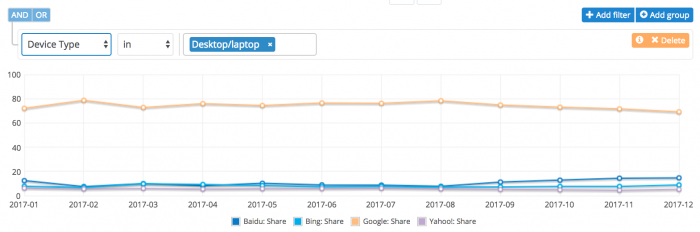
average net share of search volume

(Smart Insights)

Although 5-10% may not seem like a lot, consider that almost 50% of the world’s population accesses the Internet. That’s half of 7.6 billion people, and just 5% of that is a huge number!
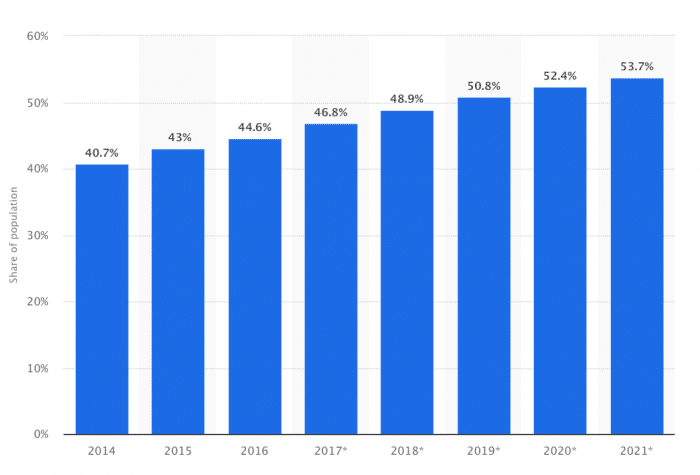
share of population

(Smart Insights)

In addition, Bing may have the edger over Google in mobile friendliness owing the more pleasing display features. And mobile search is doing nothing but growing bigger and bigger, accounting for well over half of all searches worldwide.
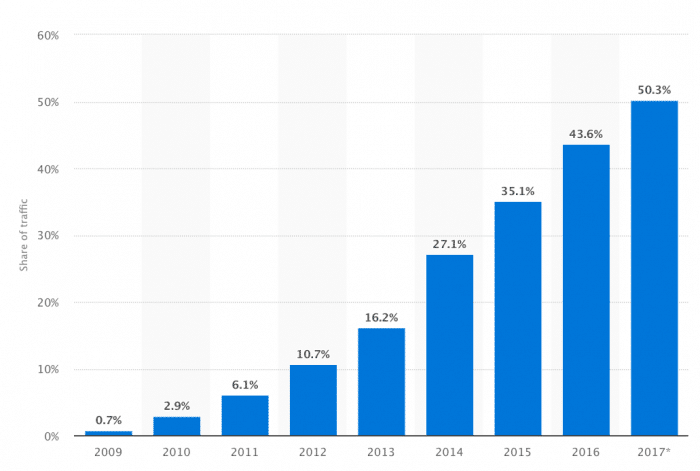
share of traffic

(Smart Insights)

If you don’t use Bing and Yahoo!, then, you could be leaving up to 20% of your marketing reach and profits on the table. It’s just sound, basic search engine optimization (SEO).

What Bing and Yahoo! do Better than Google

Besides a sizable chunk of search volume going to Bing and Yahoo!, they also do some things better than Google – and that’s why not a few people still prefer them.

Bing tops Google in . . .

Image search – The first to offer “infinite scroll,” Bing also serves up on the results page sharper, higher-quality images. Bing also does a better job with filters, including more accessible licensing information.
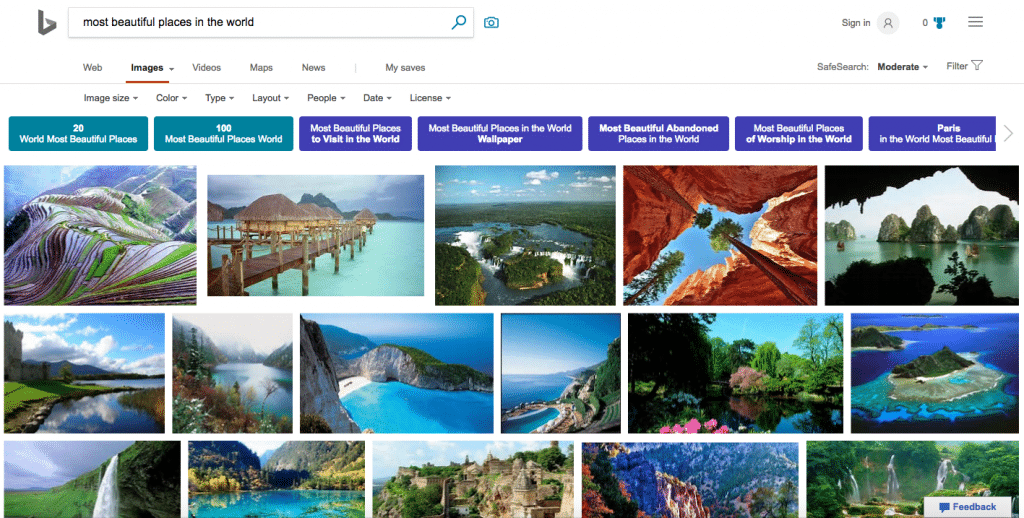
image search

(Search Engine Watch)

Social Media Integration – According to Search Engine Watch, “[w]hen it comes to social media integration with the SERPs, Bing is the clear winner. It would have been remiss of Bing not to take advantage of the deals between parent company Microsoft and Facebook and Twitter. With more access to social data, Bing results feature trending news from social media in the news search results.”

Video search – Google may own YouTube, but Bing makes video search a much more pleasant experience with the grid of video thumbnails that allow you sample videos without ever leaving the SERPs.

And Yahoo! beats out Google in these areas . . .

Homepage – Yahoo! has a more comprehensive homepage with more information and more options and with greater visual appeal.
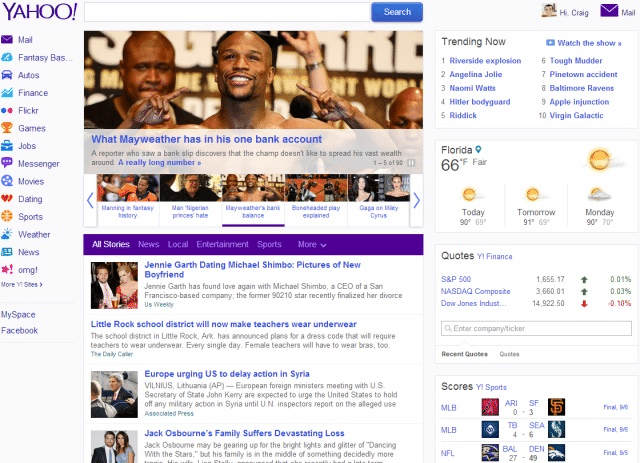
yahoo home page

(MUO)

Local-search experience – Yahoo! has been at the local-search game much longer than Google. “Yahoo! Local was the web’s first local search engine where you can see businesses and services in your area” (MUO).

Q&A database – Google doesn’t have a branded equivalent of the same caliber as Yahoo! Answers, which has been called “one of the most valuable question-and-answer databases on the entire Internet.”

How Search Engines Gather Data About Your Business

Now, before jumping into how to claim your Bing business listing and your Yahoo! business listing, it might be a good idea to examine how search engines actually gather data about your business, especially for the purposes of local search . . .

All the major search engines rely on third-party data providers for nearly all the data that shows up in their local business listings. These data providers include aggregation houses such as Acxiom and InfoUSA, common Internet Yellow Page type sites such as Superpages and Merchant Circle, and social media review sites such as Yelp and iBegin. With such a complex ecosystem of local business data, it’s important to claim your listings to consolidate all this fragmented business information under a profile that is under your own control.

Claiming your listing is also the best preventive measure against your listing being hijacked by an unscrupulous competitor, misrepresented with inaccurate information, or merged with a competitor’s data. It’s also the very first step in being able to actually optimize your business listing by hand – and the best way to ensure that your business does well in local searches.

How to Claim Your Bing and Yahoo! Listings

It’s fairly easy to create your business listing at Bing and Yahoo! Just sign up as a user at each of the respective business centers. Then, either search for your business by name and address, or add the business location by following the relevant instructions.

While you’re filling out the required business information, ensure that you’re using the Doing Business As (DBA) for your business and that you’re maintaining a consistent format for your Name, Address, and Phone Number (NAP). It’s important that you fill out this information as accurately as possible so search engines can find your business in the third-party business data they draw on and associate it accurately with your business profile. Complete your profile as comprehensively as possible:

  • Provide a keyword-rich business description.
  • Complete all the fields for business information, such as hours of operation, payments accepted, services offered, certifications, awards, parking availability, etc.
  • Upload or link to the maximum allowable number of business images and videos.

When you are ready to verify your information, you will be either contacted via:

  • Phone with a secret pin code to verify your identity, or
  • Postcard mailed to your business location.

Once you have verified your information, you now control your local business listings and optimize your online listings.

How to Set Up Your Bing Local Listings

bing listings

And here are the specific steps to claim your Bing business listing:

  1. Go to Bing Places and click “Get Started.”
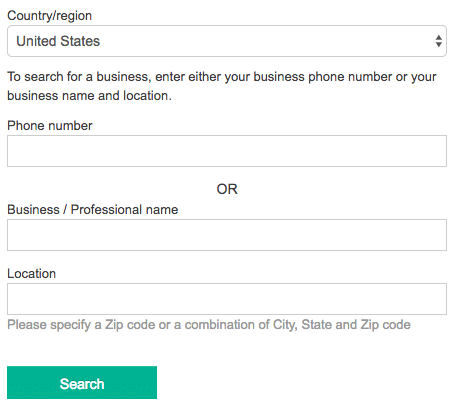
  2. Accurately enter your business details and information – phone number, business name, address, and so on – and then click “Search.” The form looks like this:form sample
  3. You should then see your business in the returned search results. Click the green “Claim Business” link that will appear to the right of your business name. If you haven’t logged in to your Microsoft account, you will then be asked to do so. After logging in, proceed to the next page.
  4. With this page, you get a chance to review your business information, making sure everything is correct:
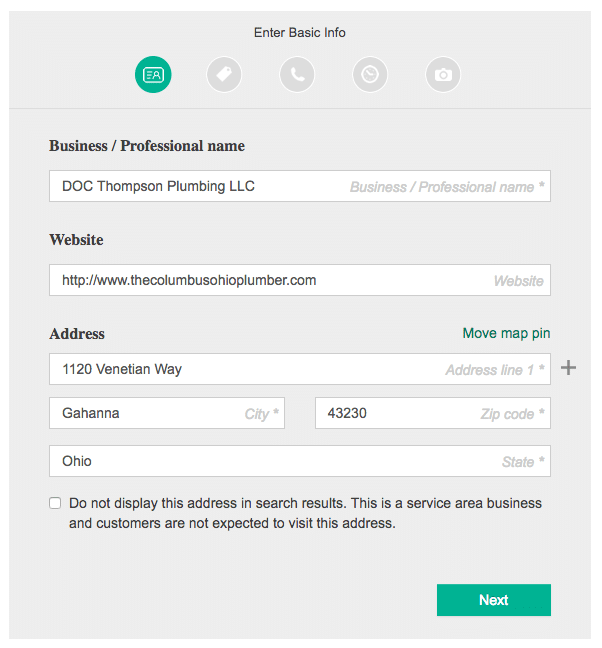
review form

Make sure all the information you see is correct and accurate for best performance in local search on Bing. Click “Next” to go to the next section, and after that hit “Submit.”

  1. Finally, you have to verify your business listing here:
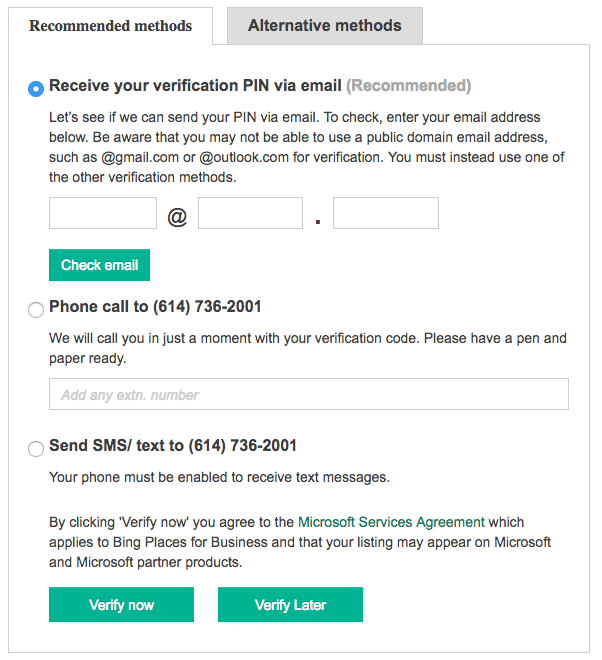
verify listing

Choose your preferred option for receiving your verification PIN or code and just follow the directions.  After you verify your business, you’ll receive a confirmation notification from Bing Places indicating that everything is on order and you’re all set.

How to Set Up Your Yahoo! Local Business Listings
yahoo listings

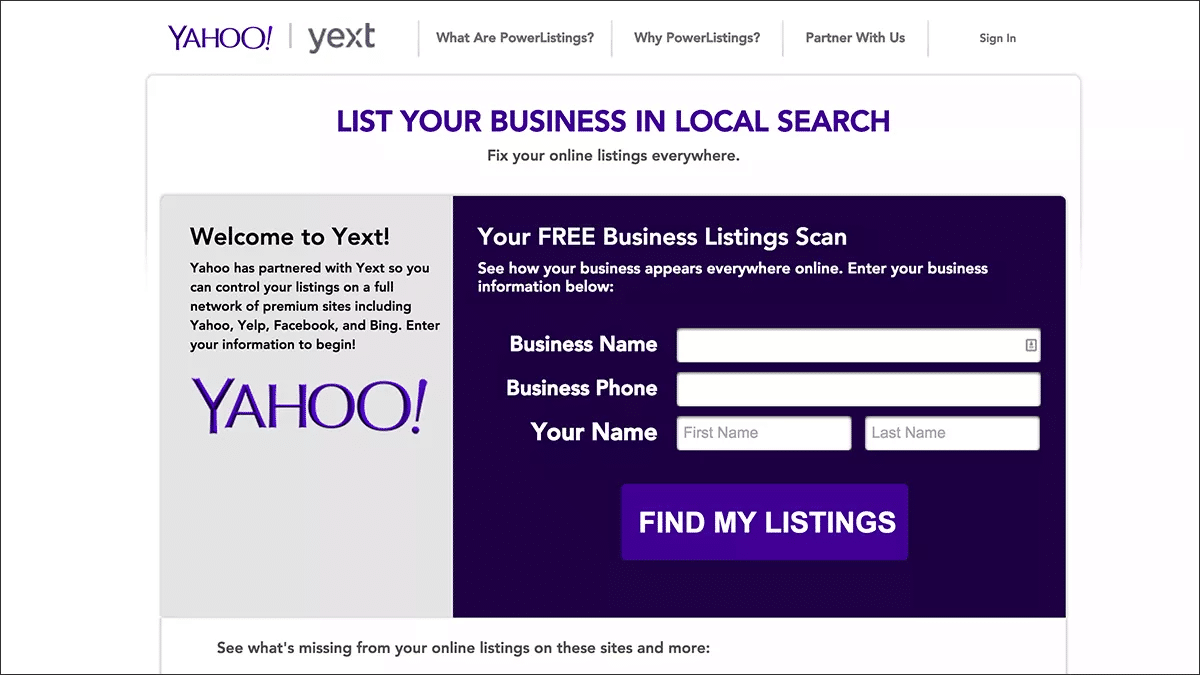
Nearly one of every eight searches in the US is conducted through Yahoo!, so, yes, you do indeed need a local business listing there. And in 2015, Yahoo made it easier by “bundling more options to publish your listing across multiple publisher sites” and moving them to Yext. This move enabled “local marketers to manage their listings for free on Yahoo or to upgrade to Yext’s PowerListings data syndication product . . . across a partner network of sites, which include Bing, Yelp, Facebook, Foursquare and others” (Search Engine Land).

Here’s how to set up your free local business listing on Yahoo! (which is very similar to the process with Bing) . . .

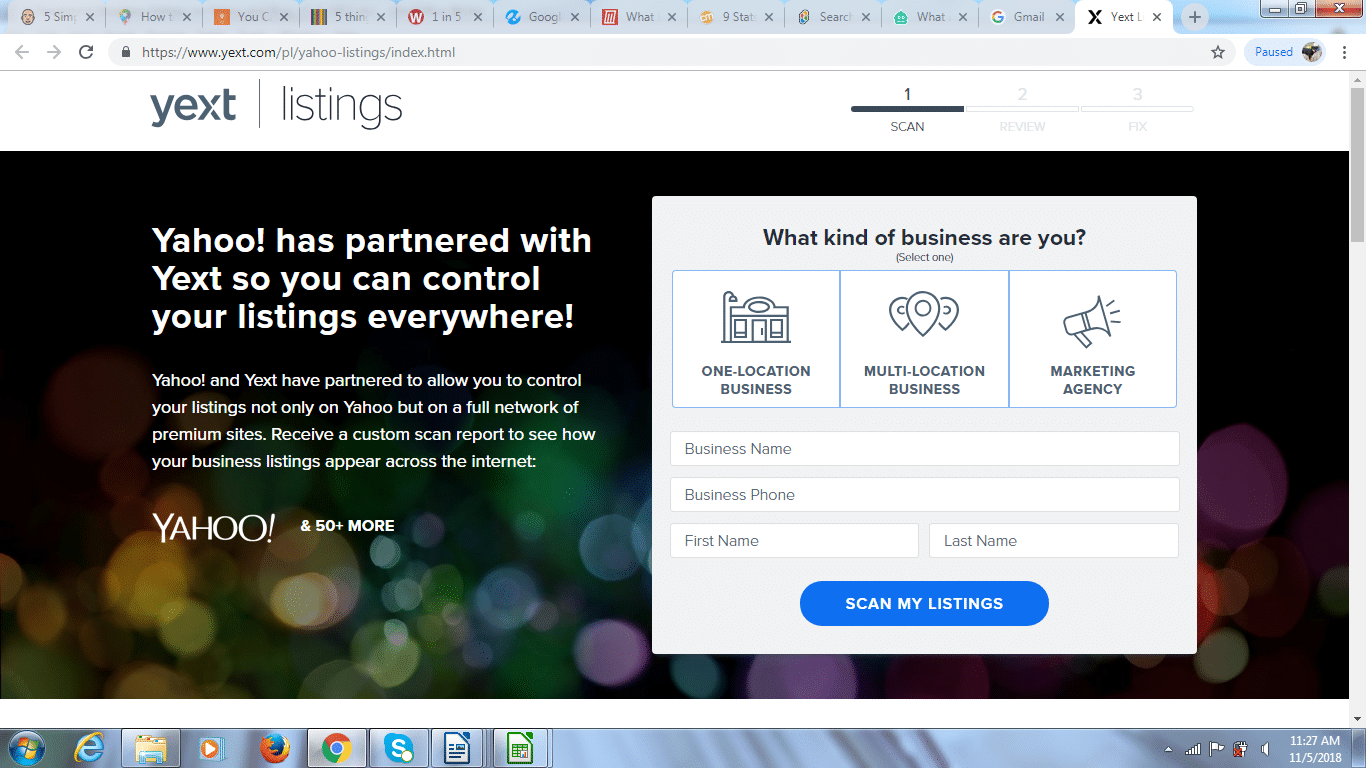
  1. Go to Yahoo!, search for your business, and you’ll be taken to this Yext form:yext form
  2. Enter your business information, and then click “Scan My Listings.”
  3.  The next page you will be taken to may seem a little off-putting with all the warnings you’ll see, but just go ahead and click the “Continue” button.
  4. At the next page, fill out or update your business information and details, making sure to fill out the page completely. Also, be sure to use the same name, address, and phone number (NAP) as you did on your Bing business listing and everywhere else. Then click “Continue.”
  5. The next Yext page will offer you some paid plans. Just look below these for the small link saying “Claim your Basic Listing in Yahoo.” This is the link you’ll want to click for your free Yahoo! business listing.
  6. And this brings you to the “Yahoo Basic Listing Checkout” page, which you’ll need to complete and then click “Place Order.”
  7.  As with Bing, the final step is verification. You will receive an email asking you to verify your email address and to log in to your account. Just click the link, create a password, and login. After this choose your preferred option to verify that you actually represent the business, then verify, and you’re good to go.

Best Practices in Claiming Business Listings

There a few best practices to ensure that you fully leverage your free Bing business listings and that you take fall advantage of your free Yahoo! business listings, for example:

  • Do not create duplicate business listings when claiming an existing unverified listing.
  • Create only one listing for every physical brick-and-mortar location you have.
  • Follow the listing guidelines for each of the major search engine local business centers.
  • Do not use call-tracking phone numbers as part of your listing.
  • When possible, use a local phone number rather than a toll-free number for additional ranking power.

Get the Most Out of Your Local Bing Business Listing and Local Yahoo! Business Listing

You may think that all this sounds like a lot of bother. It may be, but it’s also absolutely critical. For local search is rapidly becoming the most important element in SEO and marketing for businesses with a local presence. Just consider . . .

  • “96% of PC owners conduct local searches”
  • “46% of all Google searches are local”
  • “64% of local customers use search engines and directories as their main way to find local business”
  • “50% of local mobile searches look for business information”
  • “A whopping 78% of local mobile searches result in an offline purchase” (BrightLocal)

While these figures apply chiefly to Google, the same phenomenon obtains for both Bing and Yahoo! If  you want local customers to find your business, you simply have to have your business in these local listings. The key ingredient here for local businesses that want to increase traffic to their websites and through their doors is local SEO – which is way different from ranking high in the SERPS for a general search term.

There’s a lot more to it, though, than just filling out the forms and getting your information in the business listings on Bing and Yahoo!. You also have to know how to do what it takes to get your business in these listings in a way that will drive local traffic to your business – at the precise time potential customers are searching for the products or services you offer.

But you’re not an SEO expert, and, besides, you have a business to run. What you need, then, is the assistance of a digital marketing agency so that you can spend your time and talent running your business while at the same time reaping the many benefits of a local marketing plan – one that works for you right now and all the time.

Help with Your Business Listings

Contact Fingerprint Marketing today if you want to get your business on the “local map.”

Finally, even though we’ve been talking about Bing and Yahoo!, there’s still the big player Google – which, obviously, you can’t neglect. If you want to get your business on the top of the local search results on Google, take a look at our comprehensive guide on Google My Business.

The post How to Claim Your Local Business Listings on Bing and Yahoo! appeared first on Fingerprint Marketing.


Repost https://fingerprintmarketing.com/how-to-list-my-business-on-yahoo-and-bing/ fingerprintmarketing</>http://fingerprintmarketing.com/

Monday, November 5, 2018

How Marketers Leverage Google Personalized Search

Marketers generally like to use every tool available to get an edge – as they should. A fairly new twist to SEO and online marketing comes about as a result of Google’s increasingly personalized search results. The challenge with these new Google personalized searches is pinning down their accuracy due to the multiplied SERP variations. And that means a tougher time ensuring the search data is right for sound SEO purposes.

Still, effectively leveraging Google’s personalization can give you a definite marketing edge. So let’s see how personalized search results are affected by location, device type, search history, and many more factors.

What Are Personalized Search Results?

Google personalized search results are based on more than the traditional ranking factors like relevance and authority. Personalized results take into account additional information the search engine has about a user at the time of the search, for example, demographics, location, search history, and interests. The putative goal of personalized search is to enhance the relevance of the search results for a particular searcher.

Formerly, the main goal of SEO was to get to the top of the first page of Google (and other search engines) for a specific keyword or keywords. Not anymore, though, because that approach doesn’t account for specific, individual users. Now, in order to deliver the most relevant search results (as well as offering a more profitable ad experience), Google is increasingly attempting to custom tailor and personalize SERPs.

Personalized search results are based on a host of individual factors: whether you are signed into a Google account, past search history and evident interests, Google+ profile, time and date, and location. The idea is to serve up the results and content that will best satisfy your needs as a searcher. What this means in practical terms is that someone searching for, say, “affordable dentist” from Seattle using a Google Chrome account from a mobile Nexus 6 Android device at 6:00 pm will get much different results from a person searching the same keyword from Bellevue at 10:00 am on a laptop and not logged in to a Google account.

Current Trends in SERP Personalization

Chief among the trends in SERP personalization is the blending of contextual search results and personalized search results. Up until fairly recently, there had been a pretty clear line of demarcation between the two, but now not so much owing to progressively more sophisticated search engine algorithms. Contextual results used simple data points to add a layer of context to search results. Personalized results use those same data points along with more complex ones to achieve a search experience that is both contextualized and personalized – completely custom, seamless, and tailored for every distinct searcher and query.

Another major trend in SERP personalization involves resistance to over-personalization and concern about personal data tracking. Users have expressed concerns about intensive tracking of their browsing habits and personal information and about how that information was stored. The same thing has impacted marketers who had to use an incognito browser window in order to run a Google search that would allow them to view a universal listing rather than personalized results.

In addition, Google has begun to realize that there are some problems. Although they have well developed capabilities to understand the likely intent of queries and match them up with snapshot results, their interpretive abilities aren’t as strong. Google is less able to accurately predict the current desires and intent of searchers because past behavior may not be all that relevant in the present. As a result, Google has announced that they will scale back the scope of personalized searches to concentrate more on location and most recent user searches.

This last trend may make it easier for marketers to measure and track SEO efforts. In theory, marketers won’t have to worry about so much variation in SERPs from one individual searcher to the next. With customizations influenced primarily by the nature of the search query – and less by individual searcher characteristics – things become much more manageable.

But keep in mind that this is still largely conjectural, and Google personalized searches are still going strong. So fully leveraging personalized searches requires extensive SEO expertise in this area.

Which Factors Influence the Personalization Algorithm?

The many factors influencing the personalization algorithm include:

  • Where a searcher is located geographically
  • The type of device and operating system a searcher is using
  • The specific browser used
  • Search history, including kinds of searches, sites visited, and click history
  • Visit history and frequency for specific domains, with more engagement having greater influence
  • Google+ data, especially searches, shares, and links
  • Searches related to Google Calendar for Gmail users
  • Bookmarks for Google Chrome users as another indicator of visit frequency

How Search History Influences Search Results

Personalization on Google for searches is fairly heavily impacted by previous searches, especially the search results a user has clicked on and the browser history. This information allows Google to “understand” a user’s interests and then tailor the search experience accordingly.

According to SEO PowerSuite, “Google creates a personalized profile for every searcher based on their browsing history, search history, and SERP clicks, and subsequently alters the search results we see based on our interests.” And that’s where it gets tricky for marketers in their personalized search SEO efforts.

The difficulty lies in checking and tracking rankings. As with the Heisenberg Uncertainty principle, that which is observed is influenced by the action of the observer. So checking rankings influences the results observed – precisely because they are personalized. And on top of that, if a user clicked on your competitor in a search, that competitor will rank higher for that searcher because that click is part of the user’s search history used for personalizing results. In this scenario, search results will be personalized for your competitor, and you won’t know where you really stand SEO-wise.

Why Is Device Type an Important Personalization Factor?

device type

Even the type of device used is an important personalization factor, especially considering the wide divergence in SERPs for desktops/laptops and mobile devices. It is “probably fairer to call Google mobile a distinct search engine in its own right – one with its own set of ranking factors” (SEO PowerSuite).

Pages rank differently and queries are interpreted differently between desktop and mobile devices because of the algorithm’s emphasis on mobile friendliness. The significance of authority and relevance remain pretty much the same across the board, but pages that are not optimized for mobile devices are either ranked significantly lower or removed altogether. Basically, mobile-friendly pages are lifted higher in the SERPs.

For personalized SEO, then, the task becomes monitoring desktop and mobile rankings separately, as if you were dealing with two different search engines. And then you should probably put more effort into optimizing for mobile – because more than half of Google queries originate from mobile devices.

Understanding the Importance Location Targeting

Location targeting, basically Google search GPS, is another highly important aspect of personalized search and must be taken into account for effective SEO. Google knows every searcher’s location and uses that bit of information for offering personalized search results. Google can track your location best through a mobile device, with surprising accuracy and precision. But even if you’re not using a mobile device, Google can get a good idea of your location from your IP address and still do location targeting.

Using your geographic location, Google puts businesses and other relevant places nearest to you higher up in the organic personalized results. Location targeting comes into play primarily when searches indicate or imply that a searcher is looking for a physical business – which is why it is such a critical SEO factor for local businesses.

The problem for SEO here is (again) tracking rankings when there is such a wide variance in results. For example, searchers in the same city, but just a few miles apart, can see different search results when searching for the exact same term. With location changing search results so much, effective rank tracking gets more difficult.

What you have to do is determine your target locations and then set up a rank-tracing strategy, as well as the tool(s) you use, to monitor rankings for each of the different target locations. And, again, this is especially critical for local business with a physical presence. The key here is using a marketing firm with local SEO expertise.

How to Use SERP Personalization When Marketing to Your Audience

There are a few things you can do to ensure you show up higher in results for SERP personalization, such as:

Dialing in and Refining Keywords

Search results may be personalized now, but keywords remain just as important as ever. And this includes pages that aren’t primarily search landing pages because of what is called “personalization bias.” This is the phenomenon resulting from personalization whereby people who are “biased” toward your brand and click on your results are served up search results with your brand higher in the rankings. So every page needs keyword targeting, especially now that personalized search is here.

Being in the Places that Matter for Location Targeting

Getting your business in all the relevant places is the first step – Google+, Google My Business, Google Maps, and so on. In addition, you have to ensure that your content is actually helpful for searchers in those locations.

Using Google+ for Content Sharing

Google+ factors into personalized search, so don’t neglect it. Not only can you get traffic directly from sharing content on Google+, but people who click on your offerings will then see you higher in the rankings for similar searches because their searches are personalized according previous clicks and site visits.

Striving for Multi-Device Friendliness

The type of device used for searching is a huge factor in personalized search results. The upshot, then, is that you have to strive for multi-device friendliness, but maybe with a greater emphasis on mobile.

Personalize Your Search Engine Before SEO

Success in personalized search marketing begins before you do any personalized-flavored SEO. You “can perform better in personalized search . . . by thinking about things like getting potential searchers to know and love your brand and your domain before they ever make the query. It turns out that if you’ve gotten people to your site previously through other forms of navigation and through searches, you may very well find yourself higher up in people’s personalized results as a consequence of the fact that they visited you in the past” (Moz).

The great thing about this pre-SEO tactic is that it can snowball, gaining momentum and growing larger as it rolls along. If you get people to engage with your brand, you will later show up higher in the search results they see. And that means they are more likely to click on your links, which makes you show up, owing to personalization, even higher in the results they see the next time. You just keep ranking higher and higher in increasingly more of their search queries. And so on and on.

What this means, then, for your online presence, with respect to personalized search, is that you have to do some “pre-marketing” for your brand. And that also means you need a marketing partner who can do the job well.

google seo

Fingerprint for Google Personalization Success

SEO is now about more than merely getting found online by showing up high in the SERPs. It is also a matter of showing up high in the personalized search results for those people who are your exact target market. It’s a new challenge that calls for some new tactics used alongside the old tried-and-true ones that have always worked.

But do you want to have to learn all that new stuff, or would you rather concentrate on running your business? That’s where Fingerprint Marketing can help. We understand well the strategies that will help you show up in the SERPs for the right people and will bring you more local business. Our team has the qualities you need on your team. They are inventive and creative and geeky so that you can “reap the benefits of a sizzling marketing plan.”

To discover how we can help you with the challenges of personalized search, contact us today!

The post How Marketers Leverage Google Personalized Search appeared first on Fingerprint Marketing.


Repost https://fingerprintmarketing.com/personalized-search/ fingerprintmarketing</>http://fingerprintmarketing.com/
Monday, October 29, 2018

How to Get Your Business on Google Maps: Understanding Google My Business

Google+, Google Maps, Google Search – these are all important pieces of the local marketing and the local SEO puzzle. And now, thanks to the wonderful folks at Google, who have focused on giving small businesses a boost, you no longer have to manage multiple profiles to reach local customers. Google My Business now combines these several essential apps in a single turn-key, all-in-one solution – Google My Business – to have business listings in several different venues at once.

And an important piece of the Google My Business solution is Google Maps, which offers multiple services as part of the larger application, including:

  • A route planner to help travelers get from one location to another
  • The API interface that makes it possible to embed Google Maps in websites
  • Mobile capabilities that utilize GPS systems
  • Google Street View, which allows users to see and navigate through both horizontal and vertical street-level images of cities
  • Images of planets for astronomy enthusiasts

The Benefits of Google Maps for Businesses

GMB

The benefits of using Google Maps for businesses are numerous, and all of them amount to helping you get found and building that critical relationship with consumers. Consider these benefits: 

Demonstrates Quality and Fosters Approachability

A full 82% of consumers conduct online research before visiting a business, and 43% of all searches are done through Google Maps (Forbes). All those potential customers and clients doing all that searching online can take what amounts to a virtual tour of your business. And this allows them to get a feel for the quality of your business, as well making it seem less remote and more approachable and personable.

Helps Build Consumer Trust

“Establishing trust in an online context is both critical and difficult” for businesses (Inc.). But when you know how to get your business on Google Maps, you’ve taken a giant step toward establishing that trust. Google Maps Street View allows you to put a human face on an impersonal business name. And that’s the beginning of building customer trust.

Allows Better Audience Targeting

Aiming your marketing efforts at a target market is critical, and Google Maps assists you in that. For the 20 petabytes of data Google Maps allows you, there’s plenty of room to add in all the information, including photos and videos, needed to get your business in front of the people who will be interested in it. Google My Business can be a valuable tool in your local marketing and SEO toolbox.

Why and How to Add a Business to Google Maps

google maps

“Why,” you ask, “do I need to put my business on Google Maps?” Because it gets them to your store. Getting your business high in Google’s SERPs gets traffic to your website, but getting your business on Google Maps can get actual foot traffic to your store. It can give you greater, nearly passive brand reach when consumers are looking for specific kinds of local businesses.

So your next question is probably: “How do I get my business on Google Maps?” It’s pretty simple, actually, just four easy steps.

To get your new business on Google Maps, you simply have to add it on Google My Business. But if yours is an established business, it is likely already in place on Google My Business, in which case you just have to claim it. So here’s how it works:

  1. Go to Google My Business and enter your business name and address in the search box.
  2. Click on your business name if it shows up among the suggested matches. If it doesn’t appear, then select “Add your business” and provide the requested information.
  3. Verify your business so that Google can ensure that your business actually exists and is located where you said. (You may have to wait a week or two to receive a postcard with a verification PIN.)
  4. Confirm your business, using your Google-issued PIN, and set up a Google+ page.

How to List Your Business on Google Maps

gmb listing

The way you list your business on Google Maps (and throughout Google My Business) can have a pretty big impact on your find-ability and how potential customers perceive your business when they find it.

First, think about NAP – name, address, phone number – because it can be an important element in local SEO. Consistency is key, so whatever you use here should become your default address all across the web. Further, keep in mind that accurate, highly specific information about your business will allow Google to more correctly classify and better display your business listing.

You will be able to choose a category near the bottom of the Google Maps form. Google uses your category selection to classify your business, and, as a result, it will determine the kind of search query your listing will be served up for. So consider carefully when selecting from among the preset categories/keywords for each industry.

Setting Up a Google My Business Account

gmb account

Properly setting up a Google My Business account is an important first step for effective local SEO. It impacts how well your business will be found online because it connects with a host of other Google apps, tools, and venues – Google searches, Google Maps, Google+, Google Analytics, and various reviews.

The process for setting up a Google My Business account is basically the same as you use to add your business to Google Maps:

  1. Go to https://www.google.com/business/, and then create an account or sign in.
  2. Search for your business or enter it for the first time.
  3. After selecting or creating your correct business type and location, click your business name.
  4. A Google+ page will be created with the information you have put in. You then need to check “I am authorized to manage his business” and then click Continue.
  5. Finally, you’ll to go through the verification process.

Using and Managing a Google My Business Account

manage account

In addition to setting up your Google My Business account and knowing how to how to get your business on Google Maps, you will need some way to manage everything, especially if your business has multiple locations. There are several aspects to using and managing a Google My Business account, the most of important of which include:

  • Setting up your account properly – We’ve already mentioned this, but it bears repeating. For ease of use and management, your Google My Business account must be set up the right way to facilitate management from one central location.
  • Collecting each location’s account information into one place – Name and address for each business location’s website should exactly match what you have in the Google My Business listing for consistency. Google searches will then be able to see them as the same business – and not as competing businesses. A spreadsheet can be an invaluable aid here.
  • Adding new business locations in bulk – To make things easier and to help ensure consistency, you can add new businesses to your account in bulk, if you have 10 or more locations. You can use the bulk uploader, and Google will inform you if there are any discrepancies or errors.
  • Updating business information – Not only is there the first-time entry, but you will likely need to update your business information from time to time.
  • Getting help when needed – This is probably the most important because your job is running your business, not struggling with Google. So if you have any difficulty with Google My Business, don’t hesitate to call on the expertise of a company recognized for its proficiency in results-getting digital marketing and local SEO.

Tools for Optimizing Your GMB Account

optimize gmb

A good agency can help you enhance local listings and manage your account so that your GMB listing is served up to customers looking for a business just like yours. But there are also some good tools you can use to help listings perform better and achieve close to the same results.

Maybe the best and most widely known of these tools is Yext. This tool provides a way to automatically sync your business information across more than 50 directories, including Yelp, Google Maps, and Apple Siri. Yext is what is known as a digital knowledge management (DKM) platform and is used by companies like Taco Bell and Rite Aid to boost brand awareness and engagement, to drive foot traffic, and to increase sales.

Get Visual By Adding Pictures and Videos to Your GMB Listing

visual

For an even greater Google My Business strategy, you can add photos and videos to your GMB listing. They help people find your business and can come from either business owners or customers/clients. Photos, but especially videos, engage potential customers and can be a useful tool for increasing traffic.

Photos can serve different functions on your GMB listing, for example:

  • Profile photos to help consumers recognize your business
  • Cover photos to convey your business’s personality
  • Additional and various photos to spotlight particular features of your business and your offerings

The visual impact of videos, though, is much greater than that of photos. Consider that 85% of Facebook videos are viewed without the sound on (BrightLocal). GMB allows you to upload videos up to 30 seconds long, and, again, these can be added by both businesses and customers. Find out how to add photos and videos to your GMB listing here.

How to Get More Google Maps Reviews From Customers

reviews

The power of positive reviews simply can’t be overstated. And the great thing about reviews is that they take the advantage away from bigger companies and allow smaller businesses and brands to compete, especially on a local level. Here are the three main, tried-and-true techniques for getting more Google Maps reviews from customers:

Just ask – Yep, just ask for reviews. Satisfied customers will be happy to oblige, and you’ll be surprised at the positive results. Asking doesn’t break any rules, and it isn’t in bad form.

Incentivize – Give customers a good reason to leave reviews by offering some kind of incentive, usually in the form of a reward like something free or a discount coupon for the next purchase. Just be sure not to come across as too unctuous or pushy.

Follow up  – Sometimes, it may not be entirely appropriate to ask for a review at the time of purchase, say, if a customer has purchased a vacation package. In such cases, you should send follow-up emails at the right time to ask for reviews.

Contact Google My Business Support to Resolve Issues

issues

Occasionally, you may run into problems – say, error in listing information or bogus negative reviews – and in such cases you’ll need to contact Google My Business support to resolve these issues.

You have several ways available to contact the GMB folks, depending your preferred method of communication and the urgency of your issue:

  • Phone (though reports indicate that phone support is less reliable due to outsourcing)
  • Email (though, again, you may face an indeterminate wait)
  • Facebook
  • Twitter (often recommended for the relatively quick response, usually 24-48 hours Monday-Friday)
  • GMB Forum for help from expert contributors

Adding Your Business to Google Maps . . . and the Rest of the Marketing Puzzle

puzzle

As we mentioned early on, though, it’s really not enough to know how to get your business on Google Maps or how to get your business to show up on Google Maps. You must know how to get your business on Google Maps in a way that will drive local traffic to your business.

But you have a business to run. That’s where Fingerprint Marketing comes in. We understand the digital strategies that will grow your clientele. Our talented team has the qualities you need in a marketing partner. With Fingerprint Marketing, you can “reap the benefits of a sizzling marketing plan.”

Find out how by contacting us today!

The post How to Get Your Business on Google Maps: Understanding Google My Business appeared first on Fingerprint Marketing.


Repost https://fingerprintmarketing.com/how-to-get-your-business-on-google-maps/ fingerprintmarketing</>http://fingerprintmarketing.com/
Tuesday, October 23, 2018

What Makes a Good Website: Everything You Need to Make Your Website the Best

Your website is both your digital billboard and your digital storefront. It has to make a great first impression and has to do a lot of things exactly right. But does it? How many times have you come across a website and thought one (or more) of the following . . .

  • “Hey, this site looks really cool . . . but what is it really about?”
  • “This site has some interesting stuff . . .  but I don’t know how to get around in it.”
  • “I’d really like to buy one of these cool widgets, but this site just makes it too hard.”
  • “I really wanted to read that blog post, but the background and font hurt my eyes.”
  • “I’m not gonna wait any longer for this site to load.” Click

And so on . . .

As you are well aware, a lot of sites have plenty of nifty bells and whistles, some have great content, and few have products you’re just all aquiver to buy. But in the end, neither you nor the site owner gets the desired results – and for any number of reasons.

Many sites just don’t have what makes a good website. So let’s see just what that is.

What Makes a Good Website Design?

banner

At the most fundamental level, there are just four design principles that answer the question “What makes a good website design?” And those principles – or, better yet, pillars that support good website design – are:

  1. A clear and immediately recognizable purpose – When striving for good design, you must always begin with its purpose and hold it steadily in your mind. You have to ask yourself what you want every page to accomplish.
  2. Pleasing aesthetics in line with current standards – A good website design looks good – that is, it is appealing, up to date, and has pulling power.
  3. Well presented content that is both original and relevant – Good design also includes useful, original content that is aimed at the needs of a specific target market and so is relevant. And that content should be offered up in the most effective way possible.
  4. Clear, easy, and intuitive navigation – Ease of navigation matters immensely. The rule of thumb is that any page on a site should be within a maximum of three clicks from any other page on the site.

We could also talk about load speed, mobile friendliness, and any number of related matters. But, really, that is all subsumed under the four foundational principles above.

What Makes a Good Website Experience?

experience

Now, if you go at it from the user end only and ask “What makes a good website experience?” the answer isn’t quite as easy because there is a subjective element. Still, there are some identifiable objective parts to the answer. And because user experience (UX) is so vitally important, it pays to know what it involves and how to design accordingly.

If good UX design has been deployed, users will find a site:

  • Useful
  • Easily useable
  • Desirable
  • Findable
  • Accessible
  • Credible

And here’s how you can achieve those user experience qualities:

  • Design should focus throughout on UX. Everything on and in a site – layout, graphics, text, content, interactive elements – should work together synergistically to provide users a pleasant, quality experience.
  • Users do not read, but scan site pages, so the pages should be constructed so as to be easily scannable.
  • Users want and appreciate simplicity and clarity. Basically, then, you should make it apparent what you want users to do, make it easy to find action buttons, and make things consistent throughout.
  • Design elements should not be weirdly creative, but should be consonant with what users are used to seeing. There is great comfort in meeting the familiar in a new place.
  • You need to know everything you can about your target audience to that you can tailor your website design and make it a good fit for those specific users.
  • Use a visual hierarchy so that the most important elements of the interface are highlighted and user focus is trained there. This can be accomplished, for example, by manipulating size or focal point.

What Makes a Good Ecommerce Website?

ecommerce

This one’s easy to answer: whatever attracts potential customers and converts them into customers. Of course, that isn’t really very helpful, so . . .

According to Neil Patel, here’s what users want in an ecommerce website:

  • A design/layout that is organized and easy to search
  • A fast site, one with pages that take no more than two seconds to load. Studies have shown that increasing a site’s speed increases conversion rates by 78%.
  • A fairly wide, but judiciously chosen, product line. Too wide a range of products and too many products can cause customers to have decision paralysis.
  • Well categorized product pages with brief, compelling, top-level, above-the-fold product descriptions.
  • A comfortable shopping cart with an easy transaction and with no surprises like high shipping fees or limited payment methods.
  • A good post-transaction process, especially with respect to issuance of receipts.

What Makes a Good Product Listing on a Website?

product listing

Product descriptions are of utmost importance here. They have to be concise, tight, compelling, and image conjuring, executed with top-notch copywriting skill. But what makes a good product listing on a website is certainly not limited to the product description(s). It must also include:

  • Category title headers that are both informative and helpful
  • Careful selection of gridview or listview, determined in large part by the kind of products and the desired user experience
  • Careful determination of the number of products per page and per row, based on size of images, number of products, and the amount of information needed for the particular kind of product
  • Quality product thumbnails that work together harmoniously
  • Easy, intuitive navigation for a quality user experience
  • Inclusion of only the necessary product information, but all the necessary information
  • The best sorting option for the kind of products and the target audience
  • Sound on-page SEO

What Makes a Good Website Checklist?

A good website checklist will include at least the following questions and answers:

What Makes a Good Business Website?

Above all, a good business website has a clearly delineated target audience and a clearly defined and recognizable purpose, with everything built around those two things. A good business website also has to do a few critical jobs: 1) inform visitors with relevant, easily assimilable information, 2) keep them on the site long enough to take action by using simple navigation and responsiveness, and 3) convert visitors into leads and then into customers by deploying effective forms and CTAs.

What Makes a Good Website Layout?

A good website layout includes these elements and attributes: appealing and professional appearance, quality and relevant content, quick and correct functionality, usability (which means simplicity, speed, layout consistency, minimal scrolling, easy navigation, and compatibility with different browsers and platforms), and SEO.

What Makes a Good Website Background?

What makes a good website background is simply that which conveys the feel and personality of the business and complements the purpose of the site. Some of the more recent and more effective trends in backgrounds are various shades of gray, geometric patterns superimposed on photos, layers of bright color, abstract art, and asymmetry.

What Makes a Good Website Landing Page?

A landing page is a site page that a visitor lands on after clicking, say, an ad. And, simply put, a good website landing page is one that converts. Still, individual landing pages have to be tailored to work well with different offers. What makes a good website landing page – one that converts – are these qualities:

  • Essential information provided in a concise and uncluttered way
  • High-quality, rich, useful content that inspires confidence and trust
  • Limited exit points (hyperlinks) and a funneling of visitors toward the desired destination/action
  • Ease of conversion through obvious and limited steps
  • A crisp, flawless design
  • Eye-catching, compelling headlines and subheads
  • Flawless, engaging, compelling copy
  • A visitor-centric orientation
  • Easy scannability and use of videos when and where appropriate
  • An awesome, irresistible offer

What Makes a Good Website Header?

Your website header occupies one of the most valuable spots on your site. But with all the conflicting advice and extravagant suggestions out there, it’s hard to know exactly how to utilize the space.

For business-branding purposes, though, it’s pretty simple because the header isn’t quite as critical as in other design cases. In fact, it may be more effective to minimize the header to give content a more prominent position higher up on the page. So the best practice for a business is to keep everything simple, including only a logo and a tagline and thus keeping the header area smaller. But if you want an image in the header, keep it to one main hero image, one that is relevant and that clearly conveys what the site is about.

What Makes Good Content on a Website?

There are so many variable across so many sites that only a general answer is possible here. In general, then, good website content is original, top-quality, relevant, and useful – always providing a solution to readers’ problems.

What Makes a Good Mobile Website?

mobile

What makes a good mobile website is much the same as what makes a good website in general, but with some key differences, including:

  • Pages should be broken into smaller sections.
  • Image scaling is critical.
  • The design must be simplified.
  • A viewport meta tag is needed.
  • Buttons and other elements must be bigger.
  • There should be no pop-ups or refreshes.
  • Text entry for navigation should be minimized.

What Makes a Good Startup Website?

What makes a good startup website consists chiefly in the messaging. And that means that messaging should be clear, to the point, and intriguing. The job of a startup website is to get people’s attention and to stand out from the forest of similar sites.

What Makes a Website Good for Lead Generation?

lead gen

To find out what makes a website good for lead generation, we advert to Neil Patel again. He avers that “leads are only as good as the website that produces them.” That may be overstating the case, but it’s something to keep in mind. Anyhow, here are some tips for creating a good lead-generation site:

  • Be sure to include a contact number.
  • Place sign-up forms on every page.
  • Enhance credibility with testimonials and photos.
  • Speak directly to users in videos.
  • Use legitimate trust seals.
  • Use powerful, impactful, concrete language to describe your offer, not flaccid, insipid abstract words.
  • Stay away from cookie-cutter website templates.
  • Begin with the end goal in mind and keep it constantly front and center.

Be sure to test and then test again and then test some more.

What Makes a Good Website Call to Action?

CTA

First of all, realize that visitors don’t just go from landing on your site to clicking on your call to action (whatever that action is). They have to be led, guided, funneled toward – and sometimes cajoled into – taking that action and often over a period of time and after several visits.

Creating a compelling call to action, one that encourages (and results in a good percentage of the time) conversion, involves several critical considerations. The four main areas of concern for a call to action are:

  • The quality – especially with respect to being compelling and serving to build trust –  of the supporting copy
  • The timing and placement of the call to action
  • The design and appearance of the call to action
  • The effectiveness of the post-call to action experience

What Makes a Good Website 2018, and How Do You Get It?


contact us
So . . . after all this has been said, what makes a good website design? If you distill it down to its essence, you’ll find one main element in that potent solution that remains. And that is user experience.

But getting user experience right for a particular kind of website takes scads of experience and tons of research into target market, the best tools, and current design trends. Of course, you have a business to run and don’t have the time or maybe even the inclination to do all these things. Never fear: Fingerprint Marketing is here.

The web design team at Fingerprint knows that your website has to be nice looking and that it has to help your business grow and make money. That’s why the team is obsessed with making you look good online with a web presence that warms your leads, entices users to visit sooner and more often, and makes it easy for customers and clients to do business with you again and again.

To learn how to get your own well designed website, contact Fingerprint today  . . . and impress your fingerprint on the world.

The post What Makes a Good Website: Everything You Need to Make Your Website the Best appeared first on Fingerprint Marketing.


Repost https://fingerprintmarketing.com/what-makes-a-good-website/ fingerprintmarketing</>http://fingerprintmarketing.com/